MYP to IGCSE Transition: How to Move from IB MYP to IGCSE Year 10 Without Dropping Grades in Dubai Schools
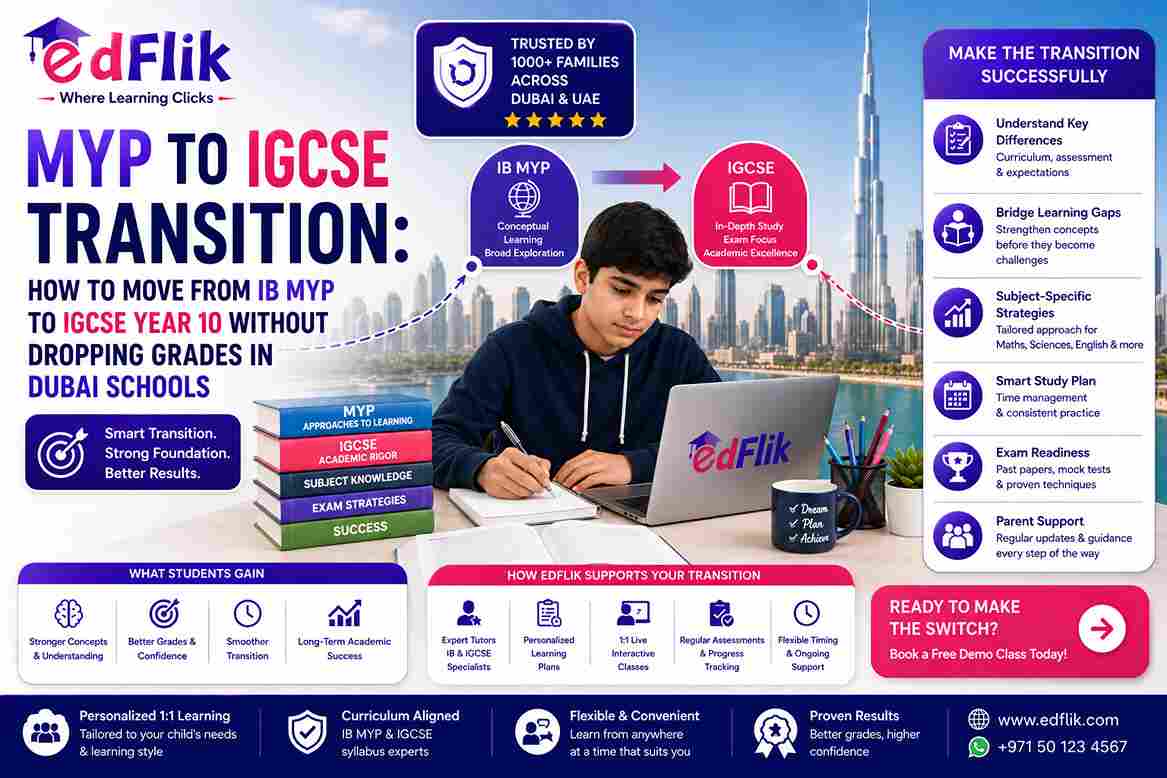
Dubai’s dynamic education landscape offers families incredible choices, but it also creates unique challenges. It is quite common for expat families to switch their children's educational pathways—such as moving a student from an International Baccalaureate (IB) Middle Years Programme (MYP) school to a British curriculum school offering Cambridge IGCSEs as they enter Year 10.
While both frameworks are globally respected, their pedagogical approaches are worlds apart. A student who achieved comfortable 6s and 7s in their MYP classes can experience a sudden and discouraging drop in performance when facing the rigid, content-heavy demands of Year 10 IGCSEs.
Here is why this transition is tricky and how students can navigate it without losing their academic footing or confidence.
1. The Core Philosophy Clash: Inquiry vs. Exam Rigor
To manage the transition, parents and students must first understand the fundamental shift in how learning is measured:
- The IB MYP Approach: Focuses heavily on inquiry-based learning, global contexts, conceptual understandings, and criterion-referenced assessments (graded out of 7). Class discussions, project-based tasks, and personal reflections play a massive role in overall success.
- The IGCSE Approach: Built as a two-year linear preparation for high-stakes external examinations. Success relies less on open-ended inquiry and much more on factual recall, structured methodologies, and precise execution under strict time limits.
When a student moves from an environment that rewards broad conceptual exploration to one that demands strict adherence to mark schemes, they often struggle with the sudden narrowing of focus.
2. The Grading System Shock (MYP 1-7 vs. IGCSE 9-1)
The psychological impact of grading differences shouldn't be underestimated. In the MYP, achieving a "6" or "7" feels attainable through consistent effort, engagement, and cross-curricular project work.
In contrast, the IGCSE system uses the 9 to 1 grading scale (where a 9 is equivalent to a high A*). IGCSE mark schemes are notoriously strict. Examiners look for specific keywords, exact definitions, and precise calculations. A student writing a brilliant, creative paragraph that lacks the specific keyword required by the Cambridge mark scheme will score zero points—a frustrating realization for former MYP students.
3. Subject-Specific Hurdles in Year 10
The friction points usually show up most clearly in core subjects:
Sciences: Integrated vs. Triple/Coordinated
In many MYP schools, science is taught as an integrated holistic subject. Entering Year 10 IGCSE often means splitting sciences into distinct disciplines (Biology, Chemistry, and Physics) or moving into Coordinated/Double Science. The volume of factual content, terminology, and chemical equations increases exponentially overnight.
Mathematics: The Structural Jump
MYP mathematics encourages multiple pathways to a solution and emphasizes real-world modeling. IGCSE Extended Mathematics requires rigorous algebra fluency, fast mental arithmetic, and multi-step execution where working out must be formatted cleanly to secure method marks.
4. Actionable Strategies to Prevent a Grade Drop
If your child is making the switch to Year 10 IGCSE in Dubai, proactive planning is essential to bridge the gap during the first term:
- Audit the Syllabus Early: Don't wait for the first term exam results. Obtain the IGCSE syllabus for each subject in August and compare it with what was covered in MYP Year 9 to identify missing foundational topics (especially in algebra and chemical bonding).
- Master the Art of the Mark Scheme: Teach your student to read past papers backwards. Looking at past paper mark schemes helps them understand exactly what Cambridge examiners are looking for, shifting their mindset from "showing understanding" to "satisfying the rubric."
- Build Exam Stamina: MYP assessments often span extended projects or digital tasks. IGCSE requires sitting down for intense, timed paper drills. Introduce short, timed writing and calculation blocks at home early in the academic year.
- Secure Targeted Mentoring: Because the teaching style changes so drastically, a specialized mentor who understands both curriculum frameworks can help translate MYP concepts into IGCSE exam-ready frameworks without dampening the student's natural curiosity.
Transitioning from the IB MYP to IGCSE Year 10 is a major milestone. By acknowledging that the rules of the game have changed and preparing for a shift in structural rigor, students can protect their grades and set themselves up for strong IGCSE results.
Frequently Asked Questions:-
Is the transition from IB MYP to IGCSE Year 10 difficult for students?
Yes, it can be challenging. The difficulty doesn't necessarily stem from harder material, but from a complete change in learning culture. While IB MYP emphasizes inquiry, broad contexts, and open-ended projects, IGCSE Year 10 demands strict adherence to mark schemes, factual precision, and formal exam techniques.
How do the grading systems compare between MYP (1-7) and IGCSE (9-1)?
The IB MYP uses a 1-7 criterion-referenced rubric that evaluates students across multiple objectives, often factoring in class participation, formative tasks, and projects. The IGCSE uses a 9-1 linear scale (where a 9 matches a high A*) determined heavily by formal, high-stakes terminal examinations where every single mark requires precise keyword alignment.
At what point in school is it best to switch from MYP to IGCSE?
The standard and most seamless transition point is at the very start of Year 10, which marks the official beginning of the two-year IGCSE syllabus cycle. Changing schools or curricula mid-way through Year 10 or entering at Year 11 makes catching up on missed coursework significantly harder.
How can parents help their child adjust to the IGCSE workload in Dubai?
Parents can support their children by identifying syllabus gaps early in the first term, replacing generalized textbook studying with active past paper practice, and setting up structured routines that build stamina for timed written examinations.