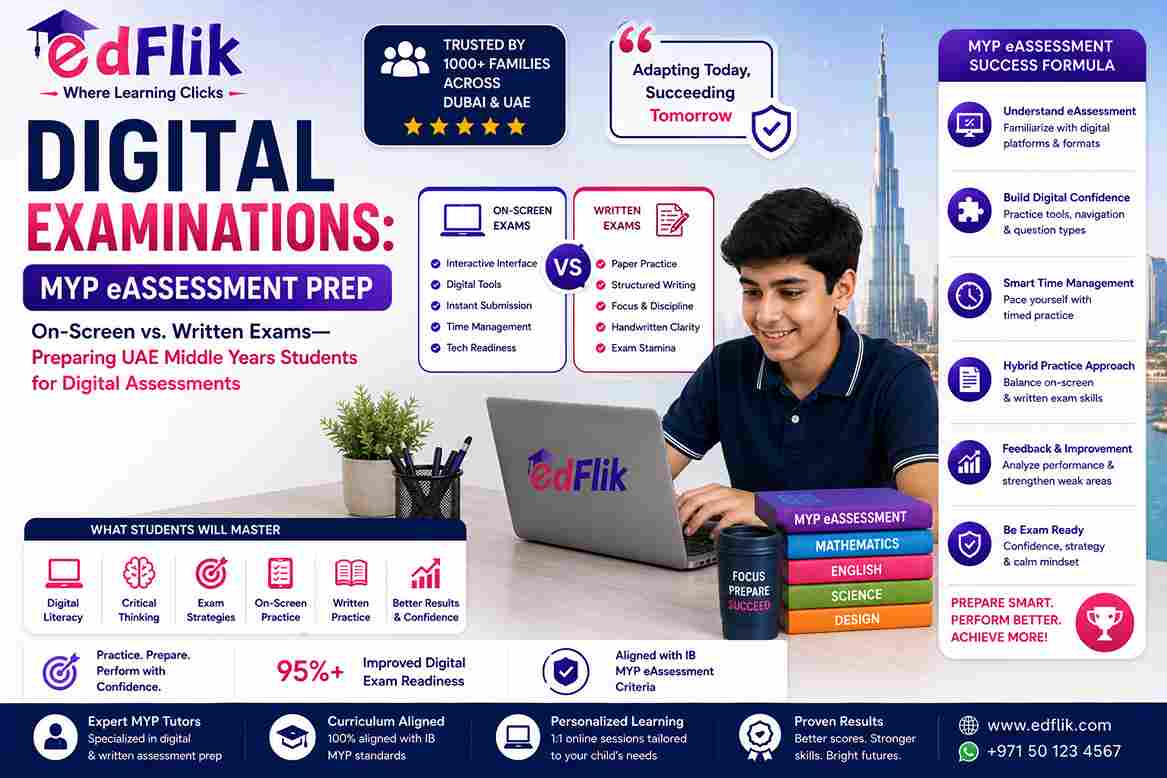
Digital Examinations: MYP eAssessment Prep: On-Screen vs. Written Exams—Preparing UAE Middle Years Students for Digital Assessments
For tech-savvy students growing up in the UAE, you might assume that moving to digital school exams would be a walk in the park. After all, Gen Z and Alpha students spend hours every day interacting with screens, laptops, and tablets.
However, educators across Dubai and the wider UAE international school community have noticed a surprising trend: when students sit down for the official International Baccalaureate (IB) Middle Years Programme (MYP) eAssessments at the end of Year 5 (Grade 10), digital native-status doesn't automatically translate to exam success.
Transitioning from traditional pen-and-paper assessments to high-stakes, on-screen digital exams introduces a completely new set of cognitive and technical challenges. Here is what parents and students need to know about the MYP eAssessment landscape and how to bridge the gap.
1. What Exactly is the MYP eAssessment?
Unlike traditional curriculum exams that rely exclusively on paper booklets and blue ink, the IB MYP eAssessment system blends on-screen examinations (externally marked digital tests in Language and Literature, Sciences, Mathematics, Individuals and Societies, and Interdisciplinary learning) with ePortfolios (internally assessed elements like Arts, Design, and the Personal Project).
The on-screen exams are not simply digital versions of paper tests (PDFs on a screen). They are dynamic, multimedia-rich environments. Students interact with:
- Interactive simulations, data sets, and graphs.
- Embedded video and audio sources for analysis.
- Specialized on-screen tools for math notation, drawing, and spreadsheet manipulation.
2. The Hidden Challenges of Moving from Paper to Screen
While writing long essays by hand has its own physical strain, typing and navigating a locked-down examination platform under intense time pressure reveals unique pitfalls:
The Typing vs. Thinking Gap
Many students can think faster than they type, or conversely, they type stream-of-consciousness text without structuring their thoughts because editing on a screen feels "fluid." Without proper training, digital essays often lack the clear paragraph structures and logical arguments that examiners look for.
Screen Fatigue and Cognitive Load
Staring into a backlit screen for a two-hour external examination while analyzing interactive maps, scientific charts, and large blocks of text causes visual fatigue far quicker than reading physical paper. Students often miss critical details hidden in tabs, scroll bars, or drop-down menus.
Technical Navigation Anxiety
During mock trials, students frequently lose precious minutes figuring out how to use on-screen equation editors, plotting tools, or multi-tab resource windows, rather than focusing on solving the actual academic problem.
3. Subject-Specific Digital Hurdles
Different subject areas present distinct technical roadblocks during eAssessments:
- Sciences: Students must interpret digital data sets, drag-and-drop variables into interactive models, and analyze experimental video clips rather than traditional static diagrams printed in a booklet.
- Mathematics: Typing complex algebraic formulas, matrices, and geometric proofs using an on-screen editor requires a completely different muscle memory than scratching calculations out on scrap paper.
- Individuals and Societies: Students are expected to parse massive digital source booklets containing charts, news articles, and historical photographs, requiring rapid digital skimming and cross-referencing skills.
4. Actionable Strategies to Prepare UAE Students for eAssessments
Preparing students for digital exams goes beyond regular academic tutoring—it requires tech-literacy combined with rigorous exam strategy:
- Simulate the Locked Environment: Do not let the official exam be the first time your child sits through a timed, two-hour test on a laptop with notifications disabled and split-screen resources open. Practice with past digital papers under exact exam constraints.
- Master the Digital Toolkit: Ensure your child is entirely comfortable using shorthand keyboard shortcuts, digital highlight tools, and specific math/science software widgets well before exam season arrives.
- Train for Structured Digital Writing: Teach students to outline their essays on physical scratch paper before transferring structured thoughts to the screen. This prevents the messy, disjointed paragraphing that often plagues digital submissions.
By understanding that the MYP eAssessment is as much a test of digital navigation and screen stamina as it is of academic knowledge, UAE parents can help their children turn high-tech exams into a distinct advantage.
Frequently Asked Questions:-
What are IB MYP eAssessments?
MYP eAssessments are the mandatory culminating assessments for students completing the International Baccalaureate Middle Years Programme (usually in Year 5 / Grade 10). They include a mix of on-screen external exams across core subjects and internal ePortfolios for practical subjects like arts and design.
Are MYP eAssessments harder than traditional paper exams?
The difficulty lies less in the content and more in the format. Students must manage screen fatigue, parse multimedia sources (such as videos, interactive maps, and data sets), and input complex answers using digital toolkits under strict time limits, which requires specific preparation.
Can students use scratch paper during digital MYP exams?
Yes. Even though the examination is completed on-screen, schools provide approved blank scrap paper for rough notes, brainstorming, and mathematical working out. Students are taught to use this paper strategically before typing their final answers into the digital portal.
How can parents help students prepare for digital exams in Dubai?
Parents can support preparation by transitioning students away from casual screen use toward structured digital exam practice. Utilizing official past papers in a timed, full-screen environment builds the exact stamina and software familiarity required to excel.